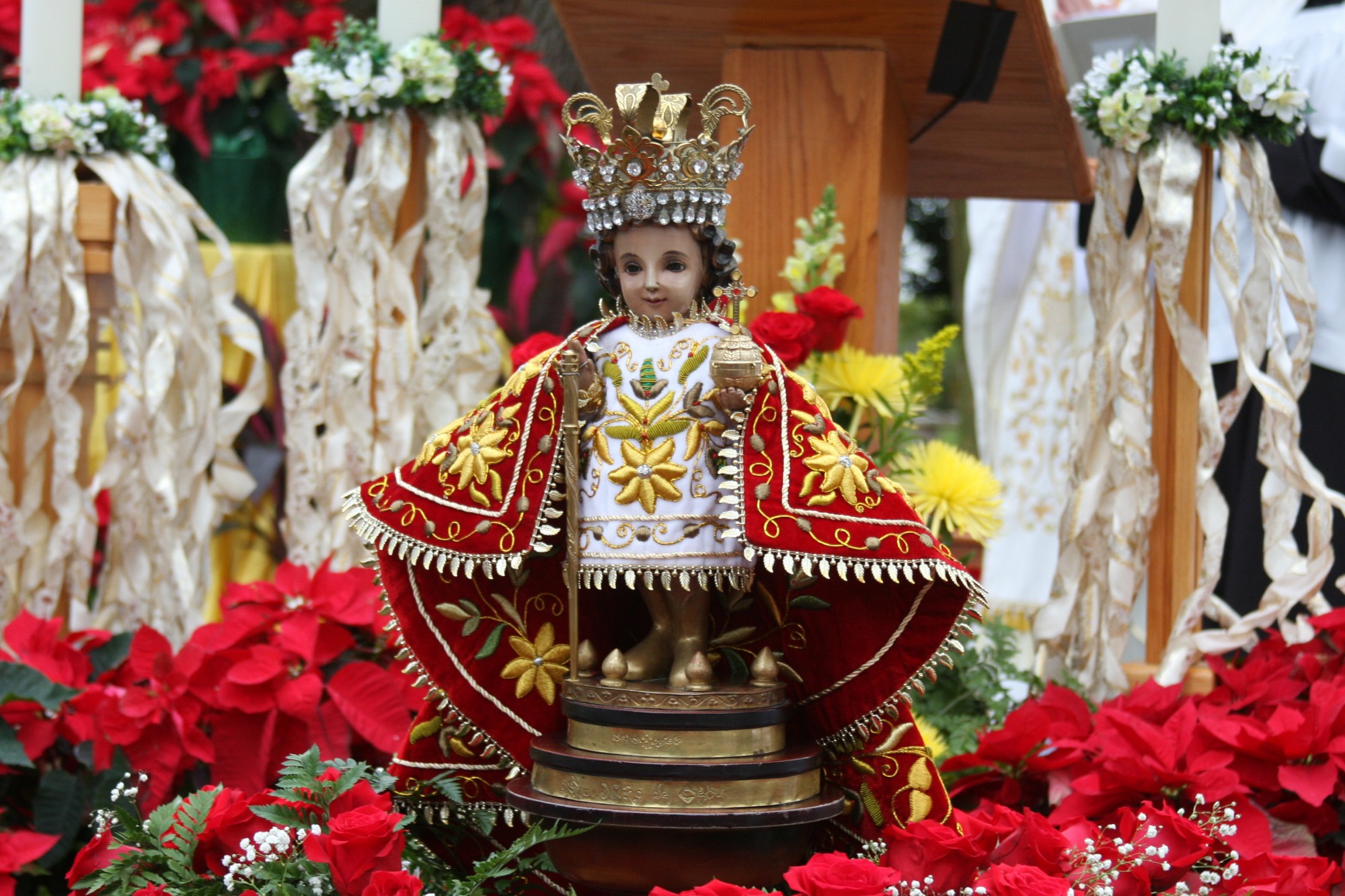

In most Filipino homes, wherever they may be – back in the Philippines or in the many countries that Filipinos have settled over the years – there are two things that I can almost guarantee they will have. Without these two items, you could argue that it’s not a Filipino home. The first is a karaoke machine, and the second, is a statue of the Santo Niño (or the Infant Jesus).
You know why most Filipinos have a karaoke machine. They simply love to sing (though I seem to be the exception to this rule!). But, I hear you ask, why is there such a great devotion to the Santo Niño among the Filipino people? Aren’t they stuck in the past? After all, Jesus grew up, did three years of ministry, died on the Cross, came back to life, and ascended into heaven. Doesn’t that make the Santo Niño redundant?
Well, if the Crucifix is the symbol of what Christ has done for us, the Santo Niño is the symbol of what he wants us to do for him. The Santo Niño is who we need to follow and emulate so that we could go to the paradise that Christ won for us by dying on the Cross. And so in a way, the Santo Niño and the Cross are inseparable. Without the Santo Niño as our model, Christ would have died for nothing.
Why do I say this? It’s because the Santo Niño is who we should aspire to become if we are to inherit eternal life. In this Sunday’s Gospel, Jesus blesses the Father for “hiding things from the learned and the clever and revealing them to mere children”. He is talking about the kind of interior peace and satisfaction that comes only to the humble, to the “childlike”, the ones willing to take Christ at his word.
Those who are “the learned and the clever” on the other hand, arrogantly demand that God explain himself completely before they agree to trust in him. That’s a reasonable expectation to have from a politician, but it’s a diabolical attitude to take in relation to God. The “learned and the clever” are the Pharisees and Sadducees, the successful people and the intellectuals — the ones who will eventually nail Jesus to a cross instead of “taking his yoke upon them”. They can’t imagine that maybe, just maybe, God knows a little bit more than they do, and so they should accept his teaching with faith, the way children trust in their parents.
This does not mean that we should behave in childish ways, but rather cultivate child-like qualities. We do this by becoming poor in spirit as exhorted in the Beatitudes: “Happy are the poor in spirit; theirs is the kingdom of heaven.” When we become a child like the Santo Niño, we become poor in spirit because, like a child, we depend on no one else but our heavenly Father.
No one can enter the Kingdom of God without being like a child. The self-sufficient, the proud, those who, because they have everything, look down on others, those who have no need even of God—they cannot enter the Kingdom of God. Only the poor, the hungry, and those who need God in their lives are the greatest in the Kingdom of God.
How do we become a child of the Kingdom of God today? We become a child of the Kingdom of God today by upholding the aspirations of the poor, powerless, marginalised, victims of injustice, intolerance and inhumanity in our own communities, parishes and the wider society. In the midst of all the calamities and miseries we experience today, the image of the Santo Niño is a powerful symbol of protest against the values and conditions that contradict the Kingdom of God—power, domination, wealth, violence, pride, injustice, exploitation, inequality and poverty.
To become a child like the Santo Niño, we need to have room in our lives for God and come to the realisation that without him, we are nothing and that we can do nothing.