Fr Antonio was invited to give a Christmas talk to the Pinner Rotary Club on 16 December 2025 at the Pinner Hill Golf Club. Here is his talk in full.
Introduction
Good evening, everyone. As already mentioned, I’m Fr Antonio Pineda, priest of the Diocese of Westminster and currently the parish priest of St Theresa of the Child Jesus Church in Headstone Lane, Harrow. I am originally from the Philippines, but I grew up in London. I studied at Cardinal Wiseman High School in Greenford, and completed degrees in business studies (which I hated) and digital media (which I loved).
John Whitehead first invited me to give a talk to the Pinner Rotary Club last Christmas. I had to decline because I had a prior engagement, but if I were to go to Confession right now, I would have to confess that I was secretly relieved. Not because I didn’t want to come, but because I didn’t think I could talk about anything that you good people would find interesting.
Well, John was smarter this year. He invited me to this evening’s occasion way back in August. Very organised … I guess, it was his way of ensuring that I didn’t have any excuses this year. As you can see, this time I said yes. But last year’s apprehension remained: what on earth could I talk about for fifteen to twenty minutes that wouldn’t send you all to sleep?
John said that I could say something about myself, perhaps my discernment story leading up to my ordination and some of the experiences I’ve had as a priest. But still, I asked myself, how interesting would that be to a group of people whom I probably do not have much in common with? I didn’t know much about Rotary Clubs, you see.
Service Above Self
Looking for inspiration for my talk tonight, I turned to good old Google for a definition of a Rotary Club. This is what it threw back at me:
“A Rotary Club is a global organisation of business and professional leaders who volunteer their time and skills for humanitarian service, aiming to build goodwill and peace, guided by the motto Service Above Self”.
Hmmm …. Service above self. That sounded vaguely familiar, somewhat relatable. You see, when I was accepted as a seminarian in 2011 (that is, someone who will be trained for the priesthood), someone I respected gave me this advice: to be a good priest, you need to become a servant of servants. To put it in biblical terms, to serve rather than to be served, just like Jesus Christ.
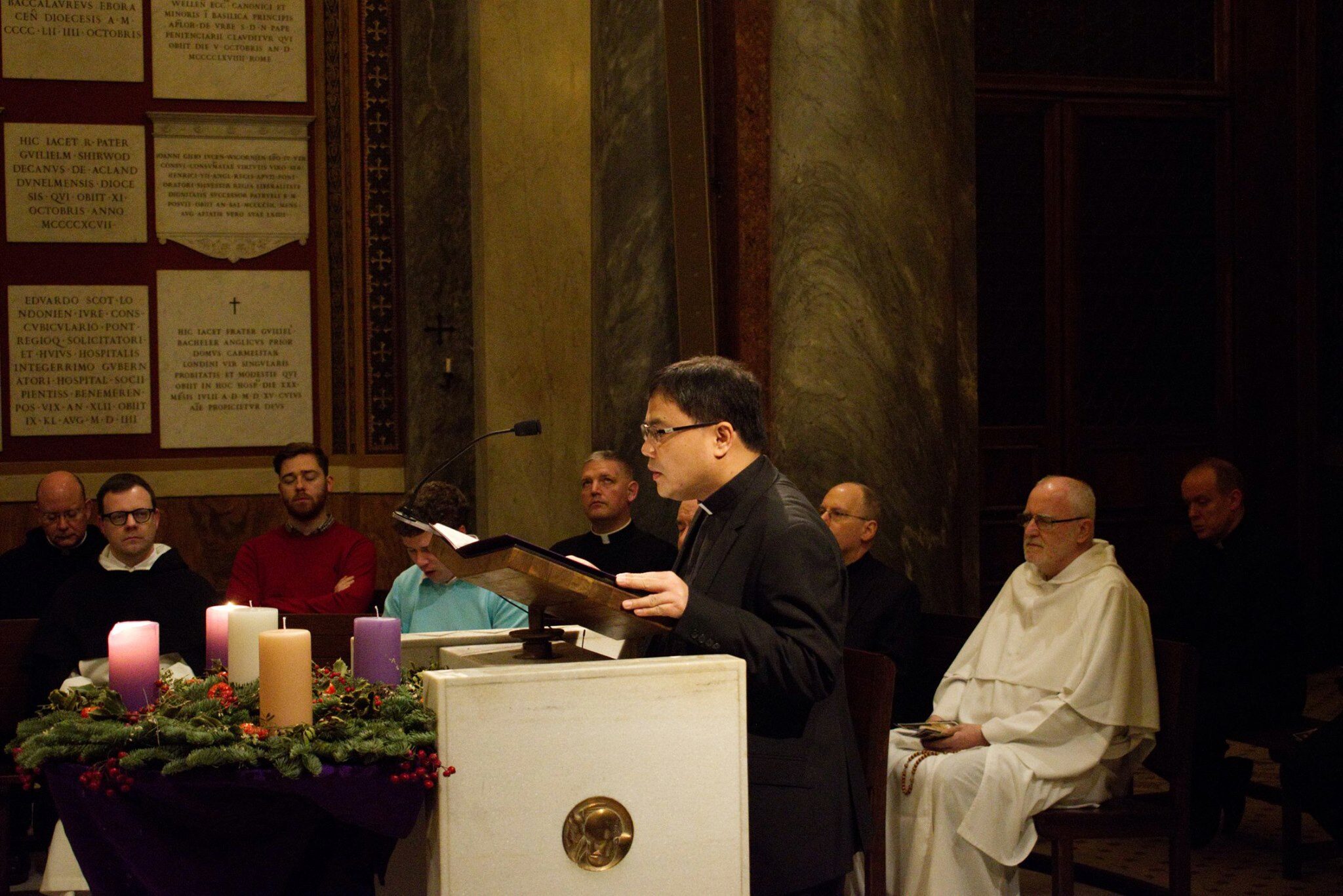
Becoming a servant of servants, or service above self, became my guiding principle during my seven years of training in Rome. My bishop, Cardinal Vincent Nichols, sent me to the Venerable English College which is the national seminary of England and Wales in Rome. His choice of seminary for me was a shock: I was expecting to be sent to Allen Hall Seminary like most other seminarians, which is our diocesan seminary in Chiswick. Not in a million years did I imagine that I would be sent to the Venerable English College, considered to be the most prestigious seminary for England and Wales. It was the Oxbridge of seminaries, if you like. I was sure it was a mistake, even when I was already on that plane to Rome in August 2011 to begin my priestly training.
Seminary Life
Well, the novelty that came with the prestige of my new home that was the Venerable English College and any sense of self-importance that I may have felt for being sent there soon disappeared when the reality of being a seminarian hit, and hit very hard. It was seven years of non-stop studying and constant exams. It was seven years of living 24/7 with other men I did not choose: some of whom were nice, and some not so nice. It was seven years of following a rigid timetable, telling us, among other things, when to pray, how to pray and whom to pray with. It was seven years of being told what to do and being disciplined when we did not do what we were supposed to do. It was a challenging life for anyone, but perhaps more so for someone like me who pretty much had total control of his life before entering seminary. I had a successful career with a good salary. I had my own flat. I was used to deciding what to do, how to do it and when to do it. All of these things stopped when I started seminary.
But of course, God works in mysterious ways. I realised later on that all those things that you’ve just heard me moan about were all part of his plans, and undeniably part of my training. Following a rigid schedule taught me discipline. Following orders without questioning them taught me humility. And somehow getting along with 50 other seminarians, with various different and clashing personalities, taught me patience. And love of neighbours.
It wasn’t all hardships and sufferings, of course. The life of a seminarian pretty much mirrors the Christian life. There is joy amid pain, peace amid turmoil, light amid shadow. Not everyone could claim to have the Pope as his neighbour, for example. But I could. The Venerable English College was within walking distance of the Vatican. For seven years, I treated St Peter’s Basilica like my local parish church. I even altar served for Pope Francis a few times. Now, that’s what I call a privilege!
I loved my formal education too when I was in Rome. Our lectures took place in pontifical universities in Rome and I shared lectures with other seminarians from around the world. I got to truly appreciate the universality of the Catholic Church by meeting and studying with other seminarians from so many different cultures. Different cultures, but same beliefs. Some of them became good friends, and I still call them as such today. One of my favourite saints, St Teresa of Avila, once wrote that God will always give you the people you need in certain situations. He certainly did so when I was in Rome. He gave me friends to sustain me in those seven years. Friends to learn from. Friends to laugh with, to cry with.
And I’d like to think he also gave me to others to sustain them.
God’s Sense of Humour
I completed my seminary training in 2018. The fact that I did must surely count as a true miracle. After all, how could I have passed my exams in Latin and Greek when I barely remember a word of either language now? And how amazing is it that I managed to get through a whole semester on the Trinity and somehow managed to pass the exam on this greatest mystery of faith, when today I still find it a challenge explaining this fundamental Christian dogma to a parishioner?
Yes, God indeed works in mysterious ways. I was ordained not far from here at St George’s Church in Sudbury. It was my home parish, where I grew up and worshipped before entering seminary. What a blessing it was to be ordained in the presence of and before my local community!
My first parish assignment was in Borehamwood in Hertfordshire. If I ever doubted that God had a sense of humour, I doubted no longer. You see, the parish priest that I had to live and work with in Borehamwood – Fr Dominic McKenna – couldn’t have been more different from me. He sadly passed away a couple of years ago, but his memory lives on especially amongst his former parishioners in Borehamwood who had worshipped and loved him. Fr Dominic was very much the extrovert, while I was very much introverted. He was outgoing, whereas I was shy. He loved public speaking, while I dread it (as I’m sure you can see for yourselves right now!). He hated silence while I thrived in it. He loved to cook, while I don’t care much for this culinary skill. Often, I found myself asking, why did God put me in with Fr Dominic when we’re so different?
God has a habit of throwing things at you to get you out of your comfort zone. It’s because when we’re out of our comfort zones that we develop. It’s when we take advantage of new opportunities, to learn to see the good in other things, the good in people. It’s when we learn that God created us all as individuals, to learn from each other, and to make up for each other’s shortcomings. In other words, we complement each other, with all of us designed to work towards unity and harmony despite our differences. We all have a role to play with our God-given gifts to achieve this.
Using Our Gifts
Speaking of gifts, I remember asking Fr Richard Nesbitt in 2011 who was then the Vocations Director for the Diocese of Westminster, that if I became a priest, would I have to give up my hobbies and interests? Would I have to stop listening to my favourite singers or stop watching my favourite TV programmes, especially EastEnders? Would I have to give up my passion for technology? I had this idea in my head that priests weren’t to like or do anything that was not holy in one way or another.
The answer was of course no. When God chooses us for a special mission, he does not want us to stop being who we are. After all, he created us the way we are. Rather, he chooses us for particular tasks precisely because of the different parts that make up our whole being, and that includes the things that set fire to our passions and imaginations. God does not want to take away from us. He wants to complete us.
Communications is perhaps my biggest passion. Both the content and the format. I worked as communications officer for several organisations before I became a priest, including the Royal College of Nursing, Caritas Manila and the London Borough of Newham. I had lead roles in the writing and editing of content for in-house publications. I also designed those publications. When the World Wide Web took over, I trained in web design and digital media. My last job before entering seminary was Web Editor at Brunel University.
Today, as a priest, I use my communications skills extensively in my ministry. Writing homilies is made easier by my previous experience of writing and editing. Equally, I use my web and digital media skills to present the Gospel to a generation of social media addicts, a generation for whom visual impact is key, and concise and up-to-date information is vital.
Ongoing Formation
I have been a priest for just over seven years now. I’m discovering that being an ordained minister is not so different from being a seminarian. I am still constantly learning. I may no longer have to follow a rigid timetable, but I still have to follow rules and indeed promote them: God’s rules. I may no longer have to live with others, but I live for others. I no longer have to pray with other seminarians, but I pray for others. I may no longer have to answer to a superior who would discipline me if necessary, but I still do things that I don’t particularly enjoy doing for the good of my flock.
In other words, as a priest I do things because I want to, not because I have to. And what a great difference this makes. When people ask me what I like about being a priest, I say I like everything about being a priest and I wouldn’t be lying. And when they ask me if I have any regrets about becoming a priest, I immediately answer none. How do I know this? It’s because I cannot imagine myself being anything else and still be happy.
Next week, much of the world will celebrate the birth of baby Jesus. He would grow up to bring peace by being a servant king.
Being a servant of servants, service above self, that’s what keeps me going today. It is what makes Christmas particularly meaningful for me. To bring Christ to people. To be there for people. To make a difference. To serve.
It is this that we are all called to do. Merry Christmas, everyone.